


››› Wellness grifter Casey Means has her day in Congress
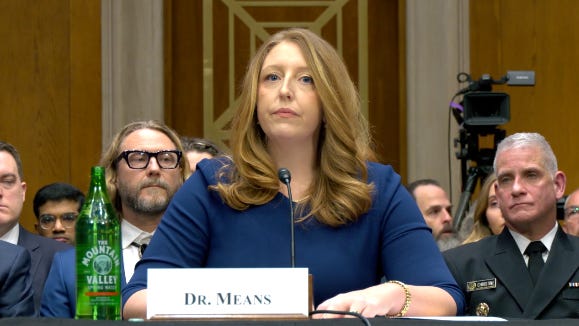
Trump’s pick for Surgeon General had her rescheduled hearing before the Senate Health, Education, Labor and Pensions (HELP) Committee this week and Democrats went surprisingly easy on her. Although Means calls herself “a physician” and Committee Chair Bill Cassidy said the Surgeon General needs to be “a steady hand of experience,” Sen. Andy Kim forced her to admit she is not currently licensed to practice medicine and cannot even write a prescription.
She answered most of the Senators’ hardest questions with some version of “ask your doctor” and, at one point, said “Blood sugar dysregulation” impacts over 50% of American adults which relates to her business of selling continuous glucose monitors.
The toughest questioning came from Sen. Chris Murphy who pointed out her conflicts of interest, something she herself decries in health care. Via The Hill:
Murphy… brought up Means’s history as an alternative medicine social media darling in which she has promoted various products and services for payment, noting she had previously failed to disclose her financial ties to these companies.
Murphy noted Federal Trade Commission rules require that people recommending products online disclose their financial ties to companies offering these products.
“There is a pending complaint regarding your failure to adhere to those guidelines that basically makes the contention, and this committee has verified the data that underlies their complaint,” Murphy said. “You routinely violated this policy, and that, in fact, in the majority of your posts for many of the products we recommend, you did not transparently reveal your financial connection.”
Although she said she believes vaccines save lives and are a key part of any infectious disease public health strategy, she refused to fully endorse the MMR vaccine under questioning by HELP Chair Bill Cassidy. “Vaccines, vaccine advocacy, or anti-vaccine rhetoric has not been part of my message,” she said. “Vaccines are not part of my core message.” “I’m not here to complicate the issue on vaccines.”
When Sen. Ed Markey asked her about the harmful impact of pesticides on people’s health, something she has frequently written about, Means significantly dialed back her normal rhetoric. This isn’t surprising given that her ally and promoter Bobby Kennedy came out in support of Trump’s Roundup Executive Order.
“There are grave issues with these chemicals,” she said. “I think that we are in a very complicated moment for agriculture and food. We cannot overturn the entire agriculture system overnight. That would hurt farmers. It would hurt food prices,” Means said. However, she also said she had the utmost respect for the American farmer” but we need to turn away from “toxic chemicals that are hurting human health” long-term.
Perhaps the strangest moment came when Sen. Susan Collins repeatedly asked her about her use of magic mushrooms or psilocybin. She said she was concerned that Means urged readers of her book to consider psilocybin therapy and that she heard an internal voice that inspired her to try psychedelic drugs. “Illicit drug use remains a huge problem in this country,” Collins said.
Again from reporting by The Hill:
Collins, holding a copy of the nominee’s 2024 book “Good Energy,” said she was “concerned” that Means encouraged individuals to use the psychedelic drug, which is also known as magic mushrooms.
The Maine Republican then asked Means whether she stood by what she wrote and how she would speak to Americans regarding illicit drugs if confirmed.
“I believe what I would say as a private citizen is, in many cases, different than what I would say as a public health official…” Means replied.
››› Trump’s 2-hour State of the Union Address
On Tuesday night, America was subjected to Trump the Showman who has a view of the world that is unrecognizable to most Americans. In this world, the economy is roaring, prices of everything are down, “illegal immigrants” are murdering everyone in sight, millions of people have been “lifted off of food stamps”, prescription drugs are almost free, and the nation’s health care problems have been solved. In other words, it’s unrecognizable because it does not exist.
During the speech, he said, “That’s why I introduced the “Great Health Care Plan.” I want to stop all payments to big insurance companies and instead, give that money directly to the people so they can buy their own health care, which will be better health care at a much lower cost.”
Here’s what NPR’s fact checkers had to say about this:
At this point, Trump’s “Great Health Care Plan” isn’t a comprehensive health policy, but an articulation of policy priorities that Trump has asked Congress to develop into legislation. He supports loosening rules around mandatory benefits required by the Affordable Care Act and promoting health savings accounts...
Even the “catastrophic” or skinny plans preferred by Trump are private insurance plans, and the money paid for them goes to big insurance companies. The only way to stop payments to health insurance companies would be to bolster public health insurance options like Medicaid and Medicare.
He also said, “I'm bringing [costs] way down on healthcare and everything else. I'm also ending the wildly inflated cost of prescription drugs like has never happened before.” He failed to mention that health insurance premiums are soaring under his administration and thanks to Republicans, or that TrumpRx doesn’t benefit most Americans.
››› Trump wants to focus on health care in the midterms and Republicans are (rightfully) worried
Despite health care being an issue where Democrats have a distinct advantage over Republicans, especially after the expiration of the Obamacare subsidies and subsequent surge in the cost of health insurance, Trump wants to lean into the issue going into this year’s midterm elections.
This is from reporting by POLITICO:
President Donald Trump is preparing to make health care a central focus of his midterm sales pitch, despite weak polling and misgivings among some of his own advisers about elevating an issue that’s long proved disastrous for the Republican Party.
The approach developed by Trump and his senior aides aims to spotlight key priorities that they believe carry broad voter appeal, like lower drug prices, while seeking to preempt an expected barrage of Democratic attacks over rising health costs…
The intensifying emphasis on health care marks the White House’s latest bid to solve the cost-of-living woes dragging down Trump’s approval ratings and deepening fears within the GOP of a midterm rout…[S]everal Republican allies working on the issue privately characterized the approach as a sign of the sheer depth of the challenge facing the administration nine months out from Election Day.
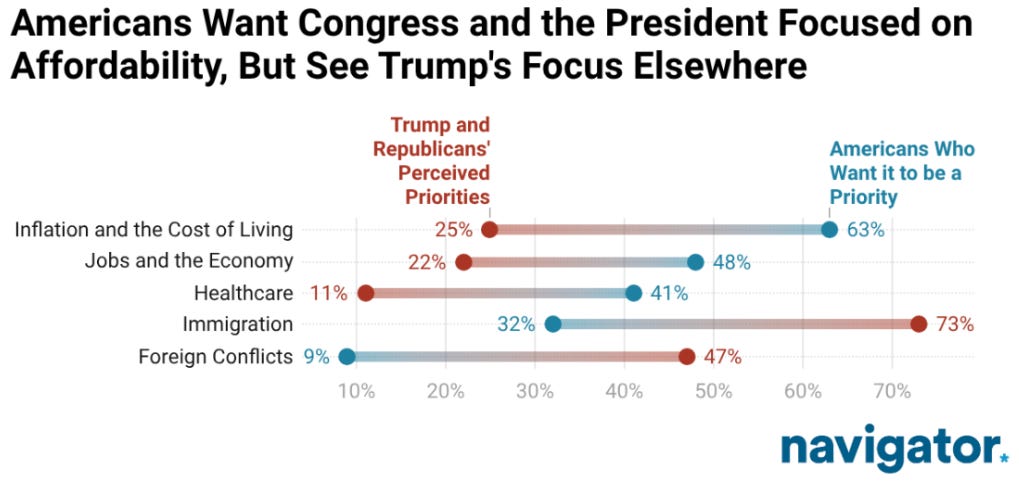
Recent polling by Navigator showed that 41% of Americans think health care should be a top priority of the administration but only 11% think it actually is:
››› Peter Attia isn’t the only doctor in the Epstein files. So is Dr. Oz.
This week we learned that Dr. Peter Attia, a longevity influencer and health care celebrity with ties to Jeffrey Epstein, is stepping down from his new position as a CBS News contributor. However, Attia isn’t the only doctor in the Epstein files. So is CMS administrator Dr. Oz:
From reporting by Reuters:
Dr. Mehmet Oz, President Donald Trump’s administrator of the U.S. Centers for Medicare and Medicaid Services, emailed an invitation to a Valentine’s Day party in 2016 to convicted sex offender Jeffrey Epstein, U.S. Justice Department documents show. [...]
Oz…sent the invite almost a decade after Epstein’s first sex crime charges became public in July 2006…The email, dated February 1, 2016, and addressed from Oz and his wife to Epstein, has a subject line reading “Mehmet and Liza Oz’s Valentine’s Day Celebration” and contains a link to a digital invite. [...]
Oz appears several more times in the files, including an email sent from an account under his name to Epstein on January 1, 2016, that has the subject line “Dr oz.” The body of the message is completely redacted.
››› Trump administration to withhold Medicaid funds from Minnesota
Vice President JD Vance announced Wednesday that the Trump administration would “temporarily halt” some Medicaid funding to the state of Minnesota over fraud concerns, as part of what he described as an aggressive crackdown on misuse of public funds.
Vance, who made the announcement with Dr. Mehmet Oz, the administrator for the Centers for Medicare and Medicaid Services, said the administration was taking the action “in order to ensure that the state of Minnesota takes its obligations seriously to be good stewards of the American people’s tax money.”
Oz, who referred to people committing fraud as “self-serving scoundrels,” said the federal government would hold off on paying $259.5 million to Minnesota in funding for Medicaid, the health care safety net for low-income Americans.
“This is not a problem with the people of Minnesota, it’s a problem with the leadership of Minnesota and other states who do not take Medicaid preservation seriously,” Oz said. [...]
President Donald Trump, in his State of the Union address on Tuesday, announced Vance would spearhead a national “war on fraud.”
››› The Trump administration may spend $2 billion annually to do things the World Health Organization did for far less
In January of last year, the Trump administration began the yearlong process of pulling out of the World Health Organization (WHO) and we officially left the organization last month. Now the administration is considering spending $2 billion per year to recreate some of the work done by WHO for a fraction of the cost.
[T]he Trump administration is proposing spending $2 billion a year to replicate the global disease surveillance and outbreak functions the United States once helped build and accessed at a fraction of the cost…
The effort to build a U.S.-run alternative would re-create systems such as laboratories, data-sharing networks and rapid-response systems the U.S. abandoned when it announced its withdrawal from the WHO last year and dismantled the U.S. Agency for International Development, according to the officials, who spoke on the condition of anonymity to share internal deliberations.
While President Donald Trump accused the WHO of demanding “unfairly onerous payments,” the alternative his administration is considering carries a price tag about three times what the U.S. contributed annually to the U.N. health agency.
According to the article, HHS has been leading the efforts and requested the funding from the Office of Management and Budget in recent weeks as part of a broader push to construct a U.S.-led rival to the WHO.
››› FDA chief Marty Makary thinks, when it comes to drugs, “Everything should be over the counter”
CNBC reports that Makary isn’t a big fan of making drugs available only by prescription:
Food and Drug Administration Commissioner Marty Makary told CNBC that he believes “everything should be over the counter” unless a drug is unsafe, addictive or requires monitoring – doubling down on a push that some in the pharmaceutical industry have questioned.
In an interview Wednesday in Washington, D.C., Makary said the FDA aims to make changes this year that allow more companies to offer their prescription medicines over the counter, or OTC. [...]
“In my opinion, everything should be over the counter and not requiring a prescription, unless it’s unsafe, unless you need laboratory tests to monitor how it’s being received by your body, or if it could be used for some nefarious purpose or it’s addictive,” Makary told CNBC after the PhRMA Forum, a one-day event organized by the pharmaceutical industry’s largest lobbying group. [...]
Some in the pharmaceutical industry have pushed back on that argument. Most OTC drugs are not covered by insurance, meaning their prices could eclipse those of generic prescription medicines and potentially make them less affordable for patients who rely on coverage.
In comments to the FDA earlier this month, the Association for Accessible Medicines argued that “the shift of many prescription drugs to nonprescription status could actually increase costs to patients, thereby decreasing patient access to treatments.”
History shows that, if a drug becomes OTC after its patent has expired, it usually becomes less expensive, not more expensive, as more manufacturers enter the market. In general, only patients with low prescription co-pays will see their costs increase if drugs are moved to OTC.
››› Rural hospitals are in big trouble
Rural hospitals have been struggling for a long time but Trump’s big bill last summer has made their situation even more perilous. The impacts are being felt across the country.
Wisconsin Public Radio reports on two rural hospitals and 19 clinics in western Wisconsin that are closing:
Cathy Tepaske calls Augusta the kind of small town where “everybody knows everybody.”
Tepaske has lived in the tight-knit community of just over 1,500 for about 30 years…Many residents see the doctor at the local clinic, she said, and have for years.
That is, until it abruptly closed earlier this year. Hospital Sisters Health System and Prevea announced a “complete exit” from Western Wisconsin in January, which included closing two hospitals and 19 clinics, including Augusta’s. Tepaske says the town was “shell shocked.”
WPSU has similar news from Pennsylvania:
Bradford Regional Medical Center will close its inpatient, emergency and long-term care services by mid-2026, marking a continuing downward trend for Pennsylvania’s rural hospitals…In a press release, the company blamed the region’s declining population and federal funding cuts.
“Federal funding cuts and long-standing financial pressures across the healthcare industry have accelerated the challenges we face and the decisions we are considering or have already made,” said Don Boyd, the president and CEO of Kaleida Health…
Links for a deeper dive on Episode #45
The Hill: Senators grill surgeon general pick Casey Means on vaccines
The Hill: Trump’s surgeon general pick won’t urge vaccines for measles, flu, whooping cough
The Hill: Collins questions Casey Means on ‘magic mushroom’ use during confirmation hearing
Trump saying he’s “lifted 2.4 million Americans off of food stamps” is HERE
CNN: Fact check: Trump makes false claims about the economy, elections and crime in State of the Union
NPR: Read NPR’s annotated fact check of President Trump’s State of the Union
CNN: Trump wants to focus on health care in the midterms, creating headaches for the GOP
Reuters: Senior US health official Oz invited Epstein to Valentine’s Day party, documents show
CNBC: Vance says administration is pausing some Medicaid funding to Minnesota because of fraud concerns
The Washington Post: After blasting WHO costs, Trump officials propose more expensive alternative
WISN: Republican Assembly Speaker Robin Vos announces he won’t run for reelection
Wisconsin Public Radio: Issue of health care access hits close to home in western Wisconsin
POLITICO: FDA’s reversal on Moderna flu shot bid followed White House pressure
RFK Jr.’s statement justifying his support of Trump’s Exec. Order on glyphosate is HERE
AP: Bayer agrees to $7.25 billion proposed settlement over thousands of Roundup cancer lawsuits
Toby Rogers on X
thereal_truther on X
Environmental Working Group: Trump’s glyphosate executive order a ‘big middle finger to every MAHA mom’